

Archive:Race 2 Space 2026 Critical Design Report: Difference between revisions
Uploaded and formatted the textual content of ARC's R2S2026 CDR. Some images are still missing due to server config |
|||
| (2 intermediate revisions by the same user not shown) | |||
| Line 115: | Line 115: | ||
In comparison with pintle injector, swirl injector promises higher combustion efficiency and more favourable manufacturing tolerances. At similar manufacturing complexity, swirl injectors outperform shear injectors in liquid-liquid operation. Mechanically, the pressure losses in swirl injector are primarily friction loss and orifice loss at its tangential inlets, which is less numerous and larger than a comparable impinging jet injector designs. This theoretically promises that swirl injectors convert pressure gradient energy to atomisation much more efficiently. Furthermore, swirl injector is a frontier capability we would like to develop more understanding of, especially in its atomisation and acoustic-coupling dynamic in hot fire operation. The demonstration of swirl injector mechanics is a primary objective of LD-A1. | In comparison with pintle injector, swirl injector promises higher combustion efficiency and more favourable manufacturing tolerances. At similar manufacturing complexity, swirl injectors outperform shear injectors in liquid-liquid operation. Mechanically, the pressure losses in swirl injector are primarily friction loss and orifice loss at its tangential inlets, which is less numerous and larger than a comparable impinging jet injector designs. This theoretically promises that swirl injectors convert pressure gradient energy to atomisation much more efficiently. Furthermore, swirl injector is a frontier capability we would like to develop more understanding of, especially in its atomisation and acoustic-coupling dynamic in hot fire operation. The demonstration of swirl injector mechanics is a primary objective of LD-A1. | ||
In design finalisation process, it was decided against the previous independent swirl elements design as it was found that the small scale of the individual element made it difficult to grab the work-piece during manufacturing process, and furthermore introduce many inter-propellant interfaces which creates additional complexity and remains extremely difficult to ensure consistent sealing for potentially negative overhead saving. The current design iteration hence simplifies the primary injector head down to only three-piece construction and completely deprecate a need for brazing. The general dimension of the injector is shown in Figure 3. | In design finalisation process, it was decided against the previous independent swirl elements design as it was found that the small scale of the individual element made it difficult to grab the work-piece during manufacturing process, and furthermore introduce many inter-propellant interfaces which creates additional complexity and remains extremely difficult to ensure consistent sealing for potentially negative overhead saving. The current design iteration hence simplifies the primary injector head down to only three-piece | ||
[[File:LD-A1 Injector head cut-away diagram.pdf|thumb|center|upright=2.0|Figure 2. - Injector head cut-away diagram]] | |||
construction and completely deprecate a need for brazing. The general dimension of the injector is shown in Figure 3. | |||
[[File:LD-A1 Injector dimension.pdf|thumb|right|Figure 3. - General dimension of coaxial injector element]] | [[File:LD-A1 Injector dimension.pdf|thumb|right|Figure 3. - General dimension of coaxial injector element]] | ||
| Line 153: | Line 155: | ||
===A4.4 Interfaces=== | ===A4.4 Interfaces=== | ||
[[File:LD-A1_Injector_head_top_view.pdf|thumb|right|Figure 5. - Top view of injector head]] | |||
The injector head redesign has significantly simplify seals and interfaces required, with the flow path mostly segregated except at the injector nozzle tip itself. The design attempts to ensure fail-safe mode of failure, where the fuel and oxidiser do not mix even in case of broken seals, such that a safe shutdown can be attempted. | The injector head redesign has significantly simplify seals and interfaces required, with the flow path mostly segregated except at the injector nozzle tip itself. The design attempts to ensure fail-safe mode of failure, where the fuel and oxidiser do not mix even in case of broken seals, such that a safe shutdown can be attempted. | ||
| Line 184: | Line 188: | ||
|- | |- | ||
! scope="row" style="text-align: left; background-color: var(--background-color-neutral-subtle);"| Burn time | ! scope="row" style="text-align: left; background-color: var(--background-color-neutral-subtle);"| Burn time | ||
| | | 5 seconds | ||
|- | |- | ||
! scope="row" style="text-align: left; background-color: var(--background-color-neutral-subtle);"| Expected oxidiser consumption | ! scope="row" style="text-align: left; background-color: var(--background-color-neutral-subtle);"| Expected oxidiser consumption | ||
Latest revision as of 03:46, 28 September 2026
Front matter
Astronautics and Rocketry Club
International Academy of Aviation Industry, King Mongkut’s Institute of Technology Ladkrabang
1 Chalong Krung 1 Alley
Lat Krabang, Bangkok 10520
Thailand
ชุมนุมอวกาศยานศาสตร์และจรวดวิทยา
วิทยาลัยอุตสาหกรรมการบินนานาชาติ สถาบันเทคโนโลยีพระจอมเกล้าเจ้าคุณทหารลาดกระบัง
๑ ซอยฉลองกรุง ๑
เขตลาดกระบัง กรุงเทพมหานคร ๑๐๕๒๐
© 2026 Astronautics and Rocketry Club (ARC)
ARC is a student organisation at King Mongkut’s Institute of Technology Ladkrabang.
Version 1.1
Published: 21 April 2026
This document is originally published solely in English.
เอกสารฉบับนี้จัดพิมพ์ขึ้นในภาษาอังกฤษเท่านั้น

This document is archived in textual form in our technical repository at
https://wiki.arcrocketry.club/w/Archive:R2S26_CDR
Copyright information
This work is licensed under Creative Commons Attribution 4.0 International.
To view a copy of this license, visit https://creativecommons.org/licenses/by/4.0/
Data and information presented in this document is for informational purposes only, without warranty of any kind. ARC is not responsible for any error, injury, or damage resulting from use or reliance on this document.
Part A. Critical design information
A1. Introduction
This Race 2 Space 2026 Critical Design Report outlines the Astronautics and Rocketry Club at King Mongkut’s Institute of Technology Ladkrabang (hereafter referred to as ARC)’s first venture to liquid rocket propulsion. Presenting, to our knowledge, Thailand’s first liquid rocket engine, LD-A1 “Nilanon”; a 1kN regeneratively cooled Kerolox engine. The Race 2 Space mission opens the opportunity for us to validate performance and demonstrate the feasibility of Thailand’s domestic rocket propulsion development (TRL-4), with special emphasis on exploration of manufacturing capabilities, especially on COTS components and adjacent-industry capability derivation.
In such pursuit, LD-A1’s chamber was designed around commercial copper tubes and configurations of traditional manufacturing techniques, with the chief goal being the realisation of internal technical readiness, for a low-cost, documented, hot-fired test article as the principal demonstrator of field viability and process workflow.
A2. Engine design overview

LD-A1 (Liquid Developmental, A-series, 1), the first iteration in Project Nilanon, is a pressure-fed regenerative 1kN-class liquid bi-propellant engine. The engine is nominally designed for LOx/Jet-A operation, chosen for its domestic availability, affordability, and relative ease of handling, higher energy density and a lower vapour pressure to ethanol. The use of hypergolic fuel was dismissed for its dangers and difficulties in obtaining the materials. The semi-cryogenic combination was deliberately chosen so that the experience may translate to a future development in other cryogenic designs. The engine is also capable of operating in a less demanding LOx/IPA combustion for this Race 2 Space as well. The engine is intended as a capability demonstrator with 5-second burn time as a success metric. Depending on observed yield and fatigue characteristics of the inner liner from the upcoming tests, the engine may be poised to attempt sustaining an indefinite burn time.
The engine operates at nominal chamber pressure of 2500 kPa (25 bars) and the designed exit pressure was selected as 0.06755 MPa (⅔ atm), in consideration for an optimal expansion of a simulated flight condition.
The engine is designed for traditional manufacturing, with emphasis on legacy capability. The small size of the engine allows the use of an adjacent but otherwise unconventional material of the field; a hard-drawn commercial ASTM Type-K copper tube, utilising existing domestic expertise and supply chain. Smaller thrust class reduces the mass saving incentive over the ease of manufacturing concern and hence a 15° half-angle conical design was chosen at this stage. Copper high thermal conductivity facilitates the opposite-flow fuel regenerative cooling design in 16 helical cooling channels at angled 45° to the main axis.The engine employs a single element oxidiser-centred internal mixing swirl injector and shall serve as a demonstration platform of ARC’s swirl injector design methodology. C* efficiency and post-test integrity is the main success metric.
A3. Engine parameter table
| Parameter | Data |
|---|---|
| Propellants | LOx/Jet-A, LOx/IPA |
| Mixture ratio | 2.0:1 (Jet-A), 1.5:1 (IPA) |
| Throat diameter | 2 cm |
| Cooling method | Regenerative cooling (Fuel) Film cooling |
| Targeted burn time | 5 s |
| Ideal performance | |
| Thrust | 1 kN |
| Chamber pressure | 2500 kPa (25 bars) |
| Chamber temperature | Jet-A: 3260 K, IPA: 3207 K |
| Specific impulse | Jet-A: 274.2 s (2.69 km/s), IPA: 264.2 s (2.59 km/s) |
| Mass flow rate | Total: 0.44 kg/s (Jet-A), 0.47 kg/s (IPA)
Oxidiser: 0.296 kg/s (Jet-A), 0.278 kg/s (IPA) |
| Injector feed performance specifications | |
| Port connectors (injector) | BSPP 1/2" to CGA440 1/2" |
| Port connectors (cooling) | BSPP 1/2" to 45° SAE 1/2" |
| Delivery pressure | Both: 3500 kPa (35 bars) |
| Ignition system | Airborne torch ignitor |
A4. Engine description
A4.1 Injector
LD-A1 employs a single independent element internal (tip) mixing oxidiser-centred liquid bi-propellant coaxial swirl injector. The motivation on coaxial swirl injector, despite the apparent design complexity, is a manufacturing consideration. With axisymmetric geometry and a relatively large element, a swirl injector is expected to be easier to machine with more rudimentary manufacturing capability. Manufacturing errors are smaller fractionally and are less operationally impactful with minor spray angle deviations.
In comparison with pintle injector, swirl injector promises higher combustion efficiency and more favourable manufacturing tolerances. At similar manufacturing complexity, swirl injectors outperform shear injectors in liquid-liquid operation. Mechanically, the pressure losses in swirl injector are primarily friction loss and orifice loss at its tangential inlets, which is less numerous and larger than a comparable impinging jet injector designs. This theoretically promises that swirl injectors convert pressure gradient energy to atomisation much more efficiently. Furthermore, swirl injector is a frontier capability we would like to develop more understanding of, especially in its atomisation and acoustic-coupling dynamic in hot fire operation. The demonstration of swirl injector mechanics is a primary objective of LD-A1.
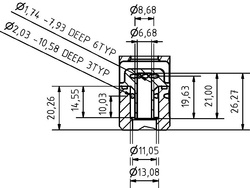
In design finalisation process, it was decided against the previous independent swirl elements design as it was found that the small scale of the individual element made it difficult to grab the work-piece during manufacturing process, and furthermore introduce many inter-propellant interfaces which creates additional complexity and remains extremely difficult to ensure consistent sealing for potentially negative overhead saving. The current design iteration hence simplifies the primary injector head down to only three-piece
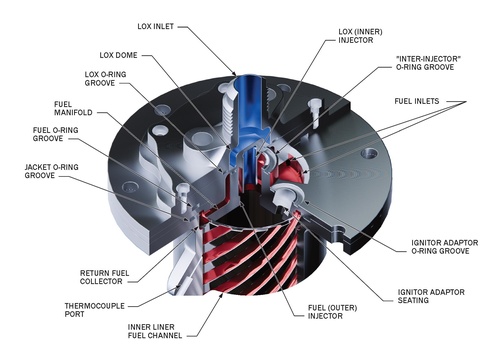
construction and completely deprecate a need for brazing. The general dimension of the injector is shown in Figure 3.
The decision to use oxidiser-centred swirl injector was due to manifold design considerations, as the engine, with fuel-cooled jacket, is substantially easier to design with liquid oxygen routed directly to oxidiser plenum without passing through fuel plenum. This is especially pertinent for the small 1kN scale of the engine which greatly limited the available geometry for complex routing with traditional manufacturing. Another chief matter of concern is in the nominal mode of operation with kerosene as liquid oxygen cryogenic temperature risks cooling down fuel to be substantially more viscous than design expectation,which could reduce the flow rate to the combustion chamber, leading to oxygen-rich operation, and the chamber wall blow-through. A catastrophic failure risk. Direct oxidiser routing reduces residence time and heat flux into liquid oxygen itself.
Additionally, oxidiser-centred design is expected to reduce the risk of oxygen-rich thermal hot spots on the combustion chamber wall near the injector face with outer fuel stage spray cone impinging and shielding a direct flow even if the operational spray cone angle is substantially different from the design angle.
Oxidiser-centred design mechanistically lead the design to be non-trivial, as higher mass flow rate demands larger swirler diameter for the same spray cone angle, and spray cone angle tending to be larger with a larger swirler diameter. This inherent geometry means typical spray cones diverge at each nozzle tip. Although it is possible to design through iteration an oxidiser-centred external mixing injector with impinging cone by the means of submerged outer stage, their characteristics are poorly characterised and do not promise greater efficiency to simpler internal or tip mixing configurations. It is however observed during testing phase that fluid film even on divergent spray fan angle, permitted that it is geometrically near by and the spray angle divergence is not extreme, the flow reattaches outside the injector element and seems to produce thinner film thickness than internal or tip mixing configuration. We have yet to quantify this difference, and although notable, the current design cycle has locked into the tip mixing configuration.
Following recommendation by Linde Thailand on liquid oxygen-safe operation, the injector material was chosen to be 316 Stainless Steel. This was considered chiefly in regards to safety and available industry experience. Nevertheless, 316SS much lower thermal conductivity reduces the fuel chilling risk.
Significant efforts have been made by the club to characterise injector geometry last year, and in the process we have developed a design calculation documented in our publication [1]. Our tool produces immediate visual feedback and allows rapid iteration on the design. The methodology follows industry standard Bazarov, Yang, and Puri [[2]. Detailed calculations are presented in A7.2. Current design iteration has had the inner element tested with water cold-flow. The result is satisfactorily as expected. A high-fidelity k-ω URANS VOF simulation is on-going. Preliminary result suggests agreement with the experimental observations.
A4.2 Thrust chamber
For regenerative cooling, a material with high thermal conductivity is favoured to aid in high heat flux transmission. For this reason, the thrust chamber has been decided at an early stage to be made of copper or copper alloys. Following a survey of available materials, we have found that a hard-drawn commercial ASTM Type-K copper tube is readily available and is affordable. From combustion volume calculations, a tube with 2-inch nominal diameter was selected. The detailed dimensions are derived from the calculation in “Initial engine sizing” on page 14

Using commercially available copper tubes is expected to significantly reduce cost and allow more iteration on fabrication prototyping of the thrust chamber itself. The ASTM 2-inch Type-K copper tube has a defined thickness of 0.083 inch (2.108 mm). With chamber thickness defined as 1 mm, the defined thickness of the pipe should serve as the cooling channel wall. The expected cooling channels manufacturing procedure is a subtractive rotary milling the channels.
The axial profile of the combustion chamber shall be fabricated with radial or rotary swaging. If possible, the swaging mould should also be machined into the chamber saddle as well.
Currently the determination of the optimum step in fabricating the chamber, whether the cooling channels should be milled first and the chamber swaged into profile or a smooth profiled chamber with channels milled later, is still on-going.
As a contingency on possible failure of this manufacturing process, it remains possible for the thrust chamber to be manufactured additively. The team has identified a local AM manufacturer. Such manufacturing path allows for higher-performance copper alloy to be used, and as such an additive manufacturing variant will most likely employ Copper-Zirconium alloy over hard-drawn Phosphorus-Deoxidised C12200 common in ASTM B88 and B280.
A4.3 Cooling jacket
The available time did not permit the team to experiment with the previously considered Electroformed nickel plating; therefore, current design follows the primary configuration of Chamber Saddle Jacket (CSJ) configuration. This design has been particularly attractive due to it the possibility of utilising existing faculty’s workshop capabilities and low expected lead time to fabrication.
The saddle was designed as a two-piece half cylindrical construction to be joined together with through bolts. The material itself is intended to be a re-purposed swaging mould for the thrust chamber’s throat swaging. Following a FDM assembly prototyping, it is found that the bolt holes are impracticably small, and the saddle hold itself adequately in position without needing bolts to join them. As the prototype showed no difficulty in inserting the saddles without bolts, the bolts through holes are hence considered optional and to be made according to the discretion of the manufacturer at fabrication.
The end cap at the exhaust side is a threaded cap with sharp flange. This design utilises the thrust chamber liner itself as a copper gasket seal to be crushed on assembly. This design was chosen in consideration of parts’ simplicity and easy disassembly. It does however damage the thrust chamber liner and as such it could not be reuse after a disassembly.
A4.4 Interfaces
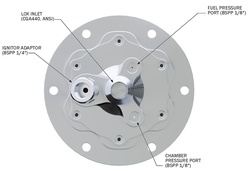
The injector head redesign has significantly simplify seals and interfaces required, with the flow path mostly segregated except at the injector nozzle tip itself. The design attempts to ensure fail-safe mode of failure, where the fuel and oxidiser do not mix even in case of broken seals, such that a safe shutdown can be attempted.
As shown in Figure 2, only the LOx dome and “inter-injector” O-rings should come into close contact with cryogenic fluids. These two, the 28.3 mm and 15.6 mm ID O-rings will be required to be PTFE face seals. Where possible PTFE seals are preferred in consideration of the engine chill-down. But except the aforementioned seals, other grooves are designed to be functional with silicone (VMQ) O-rings.
Due to its small size, there was a considerable difficulty in exposing ports and interfaces whilst avoiding intersecting flow path and maintaining manual machinability. Figure 5 shows the injector head’s port configuration from above. The difficulty is most evident in the ignitor adaptor which has to go through three plates due to space constraint. While not ideal, the design has mitigate a cross contamination risk by limiting the fuel plenum cut to be asymmetric such that the ignitor adaptor itself goes through continuous solid material only. Because adaptor port goes through inside the fuel manifold O-ring, to mitigate this, the ignitor adaptor seat has an O-ring to isolate potential fuel flow up the adaptor outer wall.
A5. Funding description
Astronautics and Rocketry Club has recently been selected to receive a $3500 grant from Definity Project courtesy of Musk Foundation for use in supporting the LD-A1 project. Although the primary plan relies on most of the manufacturing cost being absorbed by faculty’s internal fabrication and airfare supported by the university administration on reputation and student development grounds.
The grant allows minimum meaningful participation to be guaranteed by covering the total manufacturing and shipping cost. One key member is stationing in the United Kingdom and will remain so until the test date to ensure participation in case overseas travel becomes infeasible due to current geopolitical volatility.
A6. Test plans overview
| Feed performance specification | |
|---|---|
| Feed pressure | 3500 kPa (35 bars) |
| Oxidiser mass flow range | Transient (ignition): 0-0.36 kg/s Steady (operational): 0.24-0.36 kg/s |
| Fuel mass flow range | Transient (ignition): 0-0.18 kg/s Steady (operational): 0.12-0.18 kg/s |
| Test 1 values | |
| Burn time | 5 seconds |
| Expected oxidiser consumption | 1.48 kg |
| Expected fuel consumption | 0.74 kg |
The tests described hereafter are provisional and are subjected to review, nevertheless, the shape of the test could be expected to remain as described. There has been no modification to the test plan from the PDR. Whilst the current outline assumes accommodation with Jet-A or similar kerosene as propellant, LD-A1 can operate with ethanol propellant and would be tested in a similar profile to the outline below:
A6.1 Test 1 - First 5 seconds burn
The first test involves a 5 seconds burn at 100% throttle. The success of this test is the primary success metric of the engine
A6.2 Test 2 - Second 5 seconds burn
The second test uses the information from the first test to adjust and re-normalise the throttle and burn profile to the theoretical and design specifications. This test demonstrates the restart capability and the effect of thermal creep on the engine itself
A6.3 Test 3 - 80%-110%-50% throttle
The third test has a duration of 6 seconds, with ignition at 80%, in a span of two seconds the engine shall throttle to 110% and the next 2 seconds to 50%, and after that throttle down until no thrust is generated. This test aims to measure throttle performance, depth, and span.
A6.4 Test 4 - To failure burn
The final test runs the engine at 100% throttle until the engine fails, or the burn reaches 30 seconds, whichever is earlier. This test aims to demonstrate the engine maximum survivability limit and whether the transient suggests the design capability of indefinite burn.
Following a private correspondence, it was confirmed that Airborne could provide Jet-A for testing on the day. As such, the test plan assumes a campaign with Jet-A/Lox combination. However if for any reason that could not have been provided, the team would like to request that 5% PDMS additive will be added into the IPA.
A7. Planned instrumentation
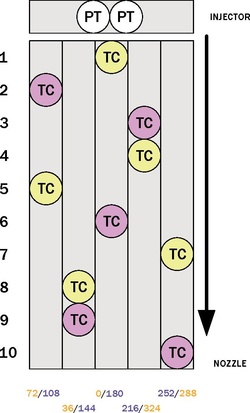
Ten N-type thermocouples are to be mounted in axial series along the chamber jacket to monitor the coolant temperature profile, where they shall be radially installed 108° apart in 10 mm deep M6x1.
Two pressure transducers shall be installed on injector assembly. One to measure the combustion pressure as a chief performance indicator. Another to measure the pressure drop in regenerative cooling channel to injector fuel manifold by comparing wit fuel delivery port measurements.
The flow path of LOx is considered short enough for the pressure drop to be negligible and the delivery pressure is considered approximately the injection pressure.
Figure 6 shows the instrumentation diagram. Using thermocouple closest to the injector plate as the datum, the diagram shows their axial sequence and angular position. The colour yellow and pink illustrate whether the port is on the top or bottom half, when TC1 is pointed straight upward.
A8. Project timeline
| ID | Task | Feb | Mar | Apr | May | Jun | Jul |
|---|---|---|---|---|---|---|---|
| 1 | Complete chamber design | ||||||
| 2 | Complete injector design | ||||||
| 3 | Injector resin print water flow test | ||||||
| 4 | Electroforming viability gate | ||||||
| 5 | Electroforming setup (COND: 4) | ||||||
| 6 | Chamber saddle jacket prototype | ||||||
| 7 | Electroform jacket prototype (COND: 4) | ||||||
| 8 | Injector fabrication prototyping | ||||||
| 9 | Injector cold flow test | ||||||
| 10 | Chamber fabrication prototyping | ||||||
| 11 | Prototype integrated cold flow test | ||||||
| 12 | Final design review, prototype end gate | ||||||
| 13 | CDR deadline | ||||||
| 14 | Flight article machining | ||||||
| 15 | Final integrated cold flow test | ||||||
| 16 | Final inspection, NDT, and packing | ||||||
| 17 | Visa and shipping preparation | ||||||
| 18 | R2S hot-fire & symposium | ||||||
| 19 | Post-competition review |
A9. Design calculations
A9.1 Injector sizing [1]
Prior to the iteration, an initial approximation of the geometric characteristic parameter is obtained from
[[2], Eqs. (61)]
[[2], Eqs. (62)]
Combining [[2], Eqs. (61)] and [[2], Eqs. (62)] eliminates and gives the general cubic
using defined as the input used to determine the flow fullness coefficient , then the injector discharge coefficient can be found. And the remaining parameters can be determined from the given explicit form of in [[2], Eqs. (72) - (74)]. With , the initial nozzle radius follows from [[2], Eqs. (103)], which forms the dimensional basis of the scheme, and the iteration may be commenced.
The required inputs are given in Table 3.
| Parameters | ||||||||||
|---|---|---|---|---|---|---|---|---|---|---|
At each iteration , dimensional geometrical parameters are reconstructed based on the following:
- Inlet radial position
- Inlet radius [[2], Eqs. (104)]
- Inlet length
- Nozzle length
- Vortex chamber radius
- Vortex chamber length
With the dimensions, the flow coefficients in inlet passages may be defined. Reynolds number with equivalent inlet diameter as the characteristic length could be formulated as
Considering
Thus
The friction coefficient is approximated based on Blasius correlations
is found using [[2], Eqs. (100)], providing corresponding to from [[2], Fig. 32]
The inlet passage tilt angle can be calculated from , and the hydraulics loss coefficient is found by linearly interpolating , then adding
The actual discharge coefficient across the injector is calculated using [[2], Eqs. (99)].
The nozzle radius of each iteration can be found from the basic mass flow relation
Rearranging gives
[[2]cf. Eqs. (103)]
which updates the geometric characteristic parameter
The residual is defined as
Iteration stops when or when a maximum of 1000 iterations is exceeded.
Using this procedure, for expected 5 bar pressure drop across the injector to 25 bar, the injector parameters for Jet-A configuration was determined to be:
| Parameter | Stage 1 | Stage 2 |
|---|---|---|
| Flow coefficient () | 0.32920 | 0.049662 |
| Geometrical characteristic () | 1.8734 | 9.7020 |
| Nozzle radius () | 3.8734 mm | 5.7768 mm |
| Inlets radial position () | 2.5378 mm | 5.7768 mm |
| Inlets radius () | 0.8683 mm | 9.2732 mm |
| Inlets length () | 3.6641 mm | 6.4912 mm |
| Nozzle length () | 13.357 mm | 4.9103 mm |
| Vortex-chamber radius () | 3.4060 mm | 6.7042 mm |
| Vortex-chamber length () | 6.3444 mm | 11.554 mm |
| Inlets tilting angle | 47.090° | 44.076° |
| Reynolds number () | 4.5288e+5 | 4.0002e+4 |
| Friction coefficient () | 0.012197 | 0.022955 |
| Loss coefficient () | 0.81180 | 0.88447 |
| Actual flow coefficient () | 0.25016 | 0.045235 |
| Recess length () | — | 5.1656 mm |
A9.2 Fluid interface flow velocity
The incompressible fluid flow velocity at their inlets can be calculated from flow rate relationship:
Rearranging yields:
Which allows inlet velocity to be determined using these parameters
| Mass flow | Inlet radius | Fluid density | Velocity | |
|---|---|---|---|---|
| LOx | 0.296 kg/s | 6.368 mm | 1141 kg/m3 | 2.036 m/s |
| Jet‑A | 0.148 kg/s | 6.00 mm | 808 kg/m3 | 1.620 m/s |
A9.3 Thermal analysis
Cooling strategies were designed in Rocket Propulsion Analysis (RPA), employing regenerative cooling and 15% film cooling. The current regenerative cooling utilises 16 opposite-flow helical fuel cooling channels at angled 45° to the main axis. The channel height is uniform 1.108 mm, with 4 mm width at chamber, variable width down at throat to 1.1 mm and 3.5 mm at exhaust. The levlev method was used as the literature have shown good agreement with the prediction in thrust chamber of this size. The coolant pressure drop is about 1 bar for Jet-A and 2 bars for IPA. Current thermal analysis for IPA does not include the effect of PDMS addition.
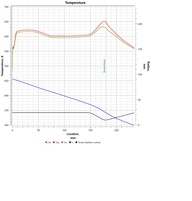
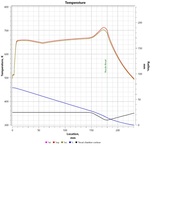
The peak gas-side wall temperature of the Jet-A configuration is 712.54 K or 441.39°C. The thermal effect on material yield strength is investigated in “Chamber stress” on page 12.
A9.4 Engine mounting


The engine bracket is designed as a 6 mm thickness mild steel folded sheet metal with two trapezoidal sheets metal ribs welded to form a 90° bracket, The bracket interfaces with the engine with six M6 bolt holes. The bottom face includes six M10 bolt holes to interface with AEL thrust table.[3]
An FEA analysis was performed with a reserve factor of 5. Therefore a load of 5 kN is applied to the mounting via a simplified engine interface. The lower bolt holes were constrained to the thrust table and lower face a frictionless roller constraint. The mounting show local yielding at bolt holes but demonstrate general safety factor of 10 across with maximum displacement of 0.169 mm
A9.5 Chamber stress
Using a conservative estimate, the chamber stress can be determined using Lamé thick-walled hoop stress equation and thermal stress from material expansion. Two calculations were performed, one as a uniform hoop at minimum 1 mm thickness, and another as a uniform thickness from smearing. The hoop stress is calculated from the formula [4]
Since the inner liner is being constrained by the outer jacket, the thermal stress is modelled as triaxial constrained, hence the formula:
Using temperature and geometric information from RPA result, a 1D stress calculation was performed. The maximum von Mises stress is 32.2 MPa at the throat (179.4 mm) with 2.09 minimum safety factor at 177.5 mm


Part B. Additional information
B1. Positionality statement
The Astronautics and Rocketry Club (ARC) is a student-driven research community at the International Academy of Aviation Industry, King Mongkut’s Institute of Technology Ladkrabang in Bangkok, Thailand. We are dedicated to advancing Thailand’s practical capabilities in spaceflight technology and building the nation's first rockets.
We are currently very fortunate to be at the forefront of Thai student liquid propulsion effort. We think our position does drive our design trade in general a little differently from a team in a country with a more established country, as many things required for our project is somewhat a blue-water experience in the country. Still, Thailand is situated at the perfect threshold of having a developed industrial expertise, especially In automotive industry, which we hope to utilise. For this reason many of our design is driven by the attempt to demonstrate capability and feasibility of a home-grown liquid propulsion programme.
As our main purpose is to develop the competency base in the country, and to initiate the programme in a way that is sustainable for any successor to emulate and continue, we have been focusing on making the design transparent and accessible, that is both in logic; by making a clear design documentation and open-access policy, and manufacturability; by making the design fabricable using traditional domestic expertise. This makes Race 2 Space competition suit our goal perfectly.
We are hoping that “Nilanon” will represent a landmark effort in Thai student rocketry landscape, proving the country can produce a technical work, if not yet proved comparable in performance, then in engineering soundness to the international standard. We hope this inspire the next generation of engineer to continue pursuing this path and help us lead the development of this field forward, for everyone.
To reiterate our tagline, we are here:
Building the nation's first rockets,
and the people behind them.
B2. Mission statement
LD-A1 “Nilanon” in this Race 2 Space 2026 campaign serves as a keystone validation of ARC’s design methodology. This project should improve our understanding on semi-cryogenic propellant system, swirl injection element, and generation cooling. This will be both a technical demonstrator and a springboard into a more advanced design including the exploration into electric pumps and larger thrust class.
If LD-A1 prove successful, the next iteration of this series, LP-A1 (Liquid Production, A-series, 1) should start development. Astronautics and Rocketry Club would as well be able to move forward toward flight engine and vehicle research.
Furthermore, the experience at Westcott will be incredibly important as there is currently no known public hot-fire facility in the country. It is expected for Thai student rocketry teams to required this capability domestically, therefore this would also be the chance to observe and learn the established professional infrastructure and procedure to ensure safety and testing success. The post-event symposium will be a good chance for the team member to get expose to the international rocket propulsion community as a whole.
B3. Initial engine sizing

The preliminary characteristics of the engine is derived from quasi-one dimensional calculation of an ideal rocket isentropic flow through nozzles[5]. Some basic characteristics are chosen:
- Propellant: Jet A1 / LOx
- Combustion pressure: 2500 kPa
- Expected thrust: 1000 N
The propellant combination was chosen for its availability, affordability, and relative ease of handling. Compare to ethanol, Jet A1 delivers higher energy density and a higher boiling point, which is crucial to its use as regenerative coolant. The use of hypergolic fuel was dismissed for its dangers and difficulties in obtaining the materials. Furthermore, experience with cryogenic fuel combination may translates to future work involving Kerolox or RP-1 propelled rockets.
The combustion pressure was chosen with consideration for engineering difficulties, as this pressure range is typical of low pressure engines and aligns with the pressures found in domestic automotive industry, particularly their experience in diesel engines. This simplifies material sourcing of material and reduces initial cost, especially regarding pumps and measuring instruments. With more experience, it may be possible to raise the combustion pressure for higher efficiency.
The exit pressure was selected as 0.06755 Mpa 0.06755 MPa (⅔ atm), in the consideration for an optimal expansion of a simulated flight conditions. The specific value is based on the Rocket Lab’s Rutherford engine purported sea level nozzle exit pressure of 0.057 Mpa. Our exit pressure is set slightly higher to account for the effect of possible flow separation and the lower material strength of the nozzle during sea level test fires.
Using NASA’s Chemical Equilibrium with Applications (CEA), an analysis was conducted to determine the appropriate oxidiser-to-fuel (O/F) ratio. Figure 11 shows the data from tabulated CEA output. It is decided that whilst O/F ratio of 2.4 may give the theoretical optimum performance, the temperature penalty and subsequent engineering difficulties that may arise outweigh the benefit at this stage, thus the fuel-rich O/F ratio of 2.0 was chosen as a compromise between performance and ease of production.
Basic dimensions of the thrust chamber were derived from equations hereafter. The values of specific thermochemical parameters were taken from an analysis using the software Rocket Propulsion Analysis [6]
First, the area ratio is obtained [[5], Eqs. (3-25)].
The exit velocity, which equals the effective exhaust velocity assuming optimal expansion, and hence the second term of [[5], Eqs. (2-16)] is cancelled. It was found to be [[5], Eqs. (3-15)]
The mass flow rate was then found using the assumption of expected thrust [[5], Eqs. (2-17)]
The throat area was obtained using the relationship [[5], Eqs. (3-24)]
Consequently, the throat diameter was approximately 1.83 cm. To standardise, it was decided to round up the throat size to 2 cm; therefore, the mass flow rate and thrust must be recalculated
The exit area was then determined to be
The volume of combustion chamber is determined using characteristic length () values in literature. For this design, an of 110 cm was selected, based on values for RP-1, which is kerosene chemically similar to Jet A-1. The combustion volume is found hence [[5], Eqs. (8-9)]
Considering the ease of manufacturing, a conical design with 15° half-angle is chosen over parabolic design for the nozzle at this stage. The nominal diameter of the thrust chamber is selected to be 2 inch (5.08 cm) based on standard specification of Type K copper tube.
B4. Swirl Injector preliminary tests
To validate the design methodology employed, a series of test is performed and on-going. Our strategy employ both experimental testing and CFD, in consideration of time, cost, and validation.
B4.1 Water cold-flow
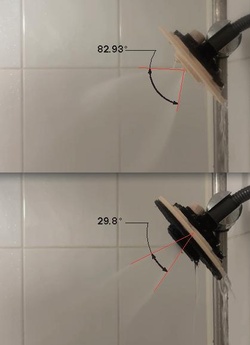
The swirl injector head was prototype with FDM to validate both assembly and flow characteristic. A water cold flow of the internal flow element was performed. Due to the preliminary nature of these tests, they were performed by re-purposing a household shower supply as a pressure source. It is recognised that the pressure supply is less than the designed inlet pressure, therefore it is expected that the flow spray cone would not be fully develop. Nevertheless, the spray cone angle is a geometric characteristic of the injector element and is stable across pressure range, therefore the assumption is made that the spray cone angle observed is roughly representative and can be extrapolate to reflect real operational spray angle, to validate the design methodology.
Figure 12 shows the preliminary experimental result. The inner injector were designed at 105° spray cone angle, the result at 82.9° (approx. 79% of design angle) is within the expected range due to long open nozzle element and lower operating pressure. However, the effect of the outer injector tip seen in lower figure, resulting in 29.8° (approx. 36% of original spray angle), is surprising. [2] predicts 35° spray angle reduction in tip cross flow yet this results in 53.1°angle reduction, although the angle may increase when the outer flow is introduced due to momentum contribution. Notably, the spray cone apex shifted in much further than in the independent flow cases.
B4.2 Computational fluid dynamics

A k-ω Unsteady Reynolds-Averaged Navier-Stokes Volume of Fluid scheme is ongoing. ARC has previously performed a similar but coarser k-ε simulation with the previous geometry which did not reached asymptotic range. At the current mesh refinement of 20 million cells, the simulation consume very significant wall time and could not be completed for this CDR. However, an early trend can be observed for the inner element and compared with the experimental result. Currently the inner spray angle is 69°and expanding, aligning with out expectation and experiment. The CFD demonstrate the extremely thin film which makes swirl injector an attractive atomiser.
References
- ↑ 1.0 1.1 T. Uhthalye and P Prapamonthon, “A web-based semi-empirical numerical tool for accessible liquid swirl injector design — IAF Digital Library,” Iafastro.directory, Oct. 2025, Available: https://dl.iafastro.directory/event/IAC-2025/paper/101978/
- ↑ 2.00 2.01 2.02 2.03 2.04 2.05 2.06 2.07 2.08 2.09 2.10 2.11 2.12 V. Bazarov, V. Yang, and P. Puri, "Design and Dynamics of Jet and Swirl Injectors," in Liquid Rocket Thrust Chambers, (Progress in Astronautics and Aeronautics: American Institute of Aeronautics and Astronautics, 2004, pp. 19-103.
- ↑ "Interface Control Document: Race2Space at AEL," Airborne Engineering Limited, 17 Nov. 2025, issue 1. [Online]. Available: https://drive.google.com/drive/folders/1W4PraYop3CXbDpQLElYTpLbHkP0JabEZ
- ↑ “Stress for Thick Walled Cylinders using Lamé’s Equations – My DataBook,” www.mydatabook.org. https://www.mydatabook.org/solid-mechanics/stress-for-thick-walled-cylinders-and-spheres-using-lames-equations/
- ↑ 5.0 5.1 5.2 5.3 5.4 5.5 5.6 G. P. Sutton and O. Biblarz, Rocket propulsion elements, 9th ed. Hoboken, New Jersey: John Wiley & Sons Inc, 2017.
- ↑ A. Ponomarenko, "RPA: Design Tool for Liquid Rocket Engine Analysis," 2009.
- L. Bayvel and Z. Orzechowski, "Design of a Swirl Atomizer," in Liquid Atomization, (Combustion: An International Series, N. Chigier, Ed. New York: CRC Press; Routledge, 1993, pp. 252-273.